
How to Choose a Tummy Tucker for Women: A Buyer's Checklist

To choose a tummy tucker, start with rise and leg length: a high waist above the navel and thigh-length shorts suit most Indian outfits and help prevent thigh rub. Then look for a wide waistband with silicone grip, a firm hold you can sit and breathe in, a seamless knit in a shade close to your skin, and your measured size.
Most women buy a first tummy shaper for one outfit: a silk saree for a cousin's wedding, a fitted kurti for Diwali, a bodycon dress for the office party. One becomes a weekly basic, another ends up in a drawer, and the difference is in the details below.
High waist or mid waist: which rise should you choose?
Rise is where the waistband ends. A mid-waist style stops around the navel; a high waist tummy tucker carries on towards the lower ribs.
- High waist suits you if the lower belly is what you want smoothed, if you sit for long hours, or if you wear high-rise trousers and lehenga skirts. It holds the whole belly from below instead of pressing into its middle.
- Mid waist can work under low-rise jeans or hip-level skirts, where a tall band might peep out. The catch: a band at the navel sits on the softest part of the belly and folds over more easily when you sit.
- Saree or short-choli lehenga: high waist still usually wins, since the petticoat ties over the band and the blouse and pallu hide its top edge. With a low drape, check the gap in the mirror.
For most wardrobes, high waist is the safer first buy, and it's the rise we chose for our tummy tucker for women.
Brief or shorts: why does leg length matter?
Leg length decides whether your thighs rub and whether the piece stays put.
- A high-waist brief ends at the hip crease. It's cooler and quicker in the washroom, but it leaves the inner thighs bare, and its leg edge crosses the seat, where clingy fabric can show it.
- Thigh-length shorts keep fabric between your thighs, so skin doesn't rub on skin through a long, sticky day under a saree, an anarkali or a dress. The edge also moves down to the thigh, where it's easier to hide.
A leg band that stops at the fullest part of the thigh tends to ride up and curl as you walk, and so does one that's a size too small. Before an event, walk around at home and sit cross-legged on the floor, as you might at a puja, then check whether the bands have moved.
How firm should a tummy tucker feel, and will the waistband stay up?
Aim for firm but comfortable: held and smoothed, never squeezed. You should be able to eat a normal meal, climb stairs and take a full breath without thinking about it. Pain, numbness, tingling or deep marks that linger after you undress mean it's too small or too firm, so stop wearing it.
Rolling usually starts at the waistband, so check three things:
- Width. A wide band spreads the pressure and folds less than a narrow strip of elastic.
- Grip. Silicone on the inside holds the band in place when you sit, bend or dance.
- A flat top edge. A thick hem shows as a ridge under a fitted kurti.
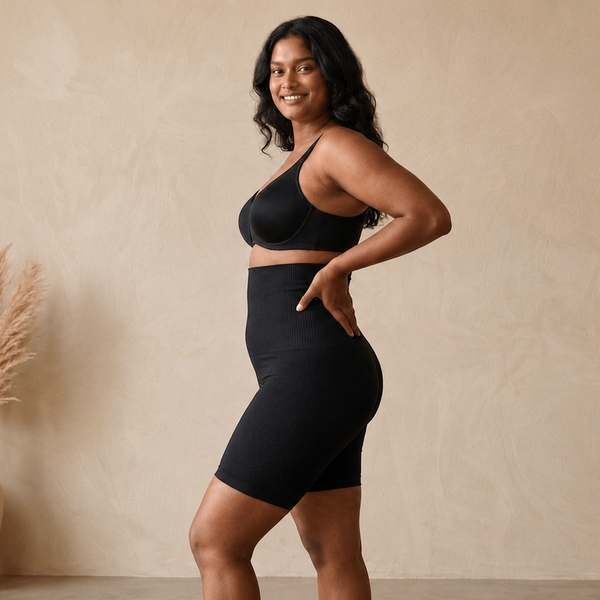
The Shapify high-waist tummy tucker ticks these boxes: a wide high waistband with silicone grip, firm, even compression across the lower belly and waist, and a seamless, breathable shaping knit. For how much hold an occasion needs, see our guide to shapewear compression levels.
A tummy tucker smooths your shape while you wear it; it doesn't reduce belly fat or change your body. If you're pregnant, postpartum or recovering from surgery, talk to your doctor first.
What should you look for under sarees, kurtis, dresses and trousers?
Each outfit tests a different detail.
| Outfit or need | What to look for | Why |
|---|---|---|
| Saree | High waist, thigh-length legs | The petticoat ties over the band, and thighs don't rub under the layers |
| Sheer or light-coloured saree | A shade close to your skin, flat leg bands | A thin petticoat can show colour and ridges in daylight |
| Kurti with leggings or palazzos | High waist, seamless front | Smooths the belly under a straight kurti |
| Bodycon or knit dress | Seamless knit, or a bodysuit instead | Clingy fabric shows any band that ends across the torso |
| Short dress or skirt | Legs that end well above the hem | The shorts stay hidden when you sit or climb into an auto |
| Office trousers | A grip band that stays flat when seated | The trouser waistband rests over it, giving one smooth line |
Seams and edges are what give shapewear away. A seamless knit has no stitched panels to print through, but check the waistband and leg bands under the real outfit, standing and sitting, by a window in daylight. Fabric that hides everything under a tube light can show a ridge outdoors.
Colour matters as much as cut. Under white, pastel and sheer fabrics, choose the shade closest to your skin rather than white, which tends to show through. Under black and dark outfits, black is safer.
How do you choose the right tummy tucker size?
- Measure. Take your waist at its narrowest and your hips at their fullest, in inches, with the tape snug but not tight. Your kurti or jeans size isn't a reliable guide.
- Check the chart. Match both numbers on the tummy tucker size chart. The range goes from XS to 4XL, then 6XL.
- Between sizes, choose the larger. Do the same if your waist and hips point to different sizes.
- Never size down for extra hold. A smaller size rolls at the waist and digs into the thighs, creating the very lines you wanted to hide.
- Measure before you order. Intimate wear can't be returned for size or preference.
To keep the hold, hand wash in cold water, don't wring, dry in the shade and skip fabric softener. Owning two lets each one dry fully between wears in the monsoon. For putting it on without twisting the legs, see how to wear a tummy tucker.
When is a bodysuit or combo the better buy?
A tummy tucker covers you from above the navel to the thighs. It does nothing for the bust, back or sides, so some outfits need more.
- Bodycon, satin or slip dresses and jumpsuits: a bodysuit, which smooths from bust to hips with no waistband edge.
- Gowns and lehengas with long, fitted cholis: a bodysuit for the torso, worn over the tummy tucker for the belly and thighs.
- Wedding days and photoshoots: both, for one line from bust to thigh. The bodysuit and tummy tucker combo pairs the two for exactly this.
- A saree with the midriff showing: the tummy tucker alone, since a bodysuit would show in the gap.
Our comparison of a tummy tucker vs shapewear vs bodysuit covers more outfits.
For most Indian outfits, choose a high waist with thigh-length legs, a wide grip band and a hold you can sit, eat and breathe in. Pick a seamless knit in a shade near your skin, in your measured size, and add a bodysuit only when the outfit is fitted above the waist.
Shop this guide
The pieces mentioned in this guide.
 Sale
Frequently asked questions
Is a high waist or mid waist tummy tucker better?
For most women, high waist. The band sits above the softest part of the belly and rolls less when you sit, while mid waist suits low-rise jeans and hip-level skirts.
Should I buy a brief or a shorts-style tummy tucker?
Shorts, if thigh rub or a smooth line at the thigh matters. A brief is cooler but leaves the inner thighs bare.
What size should I buy if I'm between two sizes?
The larger one. Check your waist and hips against the tummy tucker size chart; a smaller size rolls and digs in rather than smoothing more.
Is there a tummy tucker for ladies in plus sizes?
Yes. The Shapify high-waist tummy tucker comes in XS to 4XL, plus 6XL, with the same hold in every size.
Can I wear tummy tucker shapewear in Indian summer?
Yes, in a breathable knit and your true size, for the hours you need it. Change out of it if it's damp with sweat.